Be A Secure Base

Dear Parents,

The first year of a baby’s life is completely focused on establishing a secure attachment between the baby and primary caregiver.  This is usually referred to as a secure base.  With a well developed secure base, children literally have a brain blueprint for loving, reciprocal relationships for the rest of their lives.  They are more likely then to be resilient when life’s difficulties arise.  Securely attached children are better able to actualize their full mental capacity, moral development, cognitive functions of organization and positive decision making, and empathy for others at home and in the world.  As you can see, secure attachment is the greatest gift a parent offers a child; that beautiful, miraculous gift of love lasts throughout that child’s lifetime.  A child’s life is truly the legacy of every parent.

Adopting a child of any age means committing, as a parent, to the noble, sometimes gut wrenching task of systematically developing secure attachment; and, further, repairing the wounds in that child from the attachment breach, abandonment, and possible abuse in utero and beyond by the biological parent.

When your adopted children behave erratically out of an insecure base; when their world view’s are poorly developed for reciprocal relationships and self-regulation, your primary parenting imperative is to be the secure base your children did not get in the first year. Even if you adopted your child right from the hospital, your child’s secure base was disrupted by not going home to the arms, smell, heartbeat, and voice of the biological mother who the child knew intimately from the inside out.

Dear parents, meet your children with the eyes of empathy, compassion, and safety. When they are acting out their attachment wounds, creating chaos in your world, meet them with tender voice, soft eyes, understanding, and love; if you do, you will become the miracle of a secure base they missed out on in the early years.  What a gift you are to your child, your legacy.

The Attach Place

The Attach Place Center for Strengthening Relationships

Love matters,

Ce

The next 8 hr. Trust Based Parent Training is scheduled for April 23rd and 30th from 12noon to 4pm.  $200 per couple.  Childcare available for $30 each day, second child $10 additional. To sign up email Jen@attachplace.com and she will register you.

Monthly Adoptive Parent Support Group is every second Wednesday of the month from 5:30pm to 7:30pm.  Group and childcare are free.
Look for Ce’s Upcoming Bookpicture of cover
 
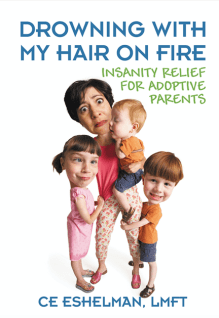
Drowning with My Hair On Fire is a compilation of over 175 daily support letters to parents of adoptive children and other children from difficult beginnings.  With a forward by Dave Ziegler, Ph.D. and a brief personal memoir, this publication is a response to blog-reader requests for a book of letters that can be easily returned to day after day, when inspiration is hard to find.
Praise for Drowning with My Hair On Fire
This woman saved our family. This book will save your sanity! After years (and many therapists) of getting it wrong, Ce Eshelman got our traumatized family on the right path to attachment, sanity, and big biglove. Ce’s unique therapy is grounded in the latest brain research, her own struggles raising traumatized children, and work with hundreds of families like ours. Her stories, contained in this book, are our stories: full of pain, confusion, hope, faith, love and practical magic that really works.
Elaine Smith, Adoptive MotherDrowning with My Hair on Fire Book Cover
Ce’s daily blog has been a lifesaver, particularly when days are most dreary and hopeless.  Not only have her words of empathy proven to be priceless to our family, but I have often forwarded them on to others.  Such a comfort to feel understood, with no judgment.
Patty O’Hair, Adoptive Mother
In a real sense “Drowning with My Hair on Fire: Insanity Relief for Adoptive Parents” is a daily mediation of struggle, success, failure and getting up and trying again.  If that sounds like too much to subject yourself to then don’t adopt a challenging child.  And one more thing, shouldn’t we require prospective adoptive parents to read “Drowning with My Hair on Fire: Insanity Relief for Adoptive Parents” rather than another ‘All they need is love’ manual?
Dave Ziegler, Ph.D., founder of Jasper Mountain Center and author of many books on raising children from difficult beginnings.

Filling The Hole With Relationships

Dear Parents,

If you are raising an attachment challenged teenager, then you probably have quite a bit of experience already with how desperate our kids can be to fill the holes in their hearts with relationships.  Sometimes the boyfriend/girlfriend revolving door is difficult to watch, so it is good to get some perspective.  I also think it is a good idea for your teen to get perspective, too.

Developing a good working narrative about one’s life can help with the slings and arrows of outrageous teen romance.  Young people do not always know they are pursuing a chemical hit of dopamine, oxytocin, and serotonin to fill up what might ordinarily be a painful, achy void at their centers.   Cognitively linking the void feeling to the experience of grief and loss in a difficult childhood can be the beginning of healing the wounds.  The teen years is a super good time to work on their personal narratives again, even if you think you already did it when they were younger.  This time it will be from a new more cognitively aware viewpoint.

I encourage you to get outside therapeutic support to do this coherent narrative work.  You may have noticed that teenagers do not really enjoy listening to their parents.  Throw some attachment challenge on that and it can get pretty fiery.  Do yourself a favor and enlist help.

Love matters,

Ce

Little Talks

Dear Parents,

When I am the most frustrated with parenting repetitiously, the best antidote for me is a little talk with my child.  That has always been a secret remedy.  I find out the most interesting things when I bother to listen my frustration out.  I don’t mean lecture, then listen. I mean slow down and hear.

What I often find is that my children have completely distorted something I have said or misinterpreted something they have heard.  There are times when I am gob-stopped by what notions my children are harboring due to plain misunderstanding.

Here are just a few of the many interesting things I learned over the years through little talks:

  • At twelve, my daughter thought my caucasian husband and her step-father of eight years was African American because he had a tan most of the year.  At the time this notion hit her, he drove a convertible, so…unhealthy tan.
  • At fourteen, I overheard my son tell a friend of his that we were rich.  Really?  I had about $400 dollars in the bank, which by many standards is rich; however, I wouldn’t say we were rolling in dough. When I asked him why he thought that, he said because I told him we were rich.  When I thought about it, I realized I had repeatedly told my children since they were very young something like, We have everything we need in life because we are rich with love.  Since he didn’t understand the concept, he held on to the part he did understand.
  • At nineteen, the young woman I am fostering due to her homelessness walked to Target to buy something with the allowance I give her. On her way home, she held a lengthy conversation with a homeless man, gave him a hug, and twenty dollars.  She said, I’ve been homeless, so I wanted to give him something. Sweet heart, but theoretically she is still somewhat homeless, and whatever happened to, Don’t talk to random strangers and definitely resist randomly hugging them while alone near an alley?  I thought all that was implied in, Be very careful.  Guess not.
  • Recently my son announced to all of his friends and family that he was transgender and went about planning his transition to a girl.  All of us were, uh, incredulous because this is something that has never been on the horizon.  Ever.  He was very disappointed and angry when I told him I could not shell out $50,000 to complete a transition.  Torn between being supportive and being the voice of reason, we had several little talks and I finally discovered that he had been conversing online for quite some time with a couple of transitioning adults and thought some of their feelings pre-op fit him.  Because he has severe Sensory Integration Disorder his proprioception issues cause him to be delicate with how he engages his environment. He interpreted this as being like a girl.

The little talks you have with your children can reveal many things that cause behavior that can be trying to you as a parent.  My children only engage in little talks when it is very quiet in the early morning or late evening hours.  Sometimes it is hard to give up my only personal time to pursue the internal workings of my children.  I have to tell my inner tantruming teenager to suck it up, my actual child’s needs are more important.

The Attach Place

The Attach Place Center for Strengthening Relationships

Love matters,

Ce

The next 8 hr. Trust Based Parent Training is scheduled for April 23rd and 30th from 12noon to 4pm.  $200 per couple.  Childcare available for $30 each day, second child $10 additional. To sign up email Jen@attachplace.com and she will register you.

 Monthly Adoptive Parent Support Group is every second Wednesday of the month from 5:30pm to 7:30pm.  Group and childcare are free.

Look for Ce’s Upcoming Bookpicture of cover

 
Drowning with My Hair On Fire is a compilation of over 175 daily support letters to parents of adoptive children and other children from difficult beginnings.  With a forward by Dave Ziegler, Ph.D. and a brief personal memoir, this publication is a response to blog-reader requests for a book of letters that can be easily returned to day after day, when inspiration is hard to find.
Praise for Drowning with My Hair On Fire
This woman saved our family. This book will save your sanity! After years (and many therapists) of getting it wrong, Ce Eshelman got our traumatized family on the right path to attachment, sanity, and big biglove. Ce’s unique therapy is grounded in the latest brain research, her own struggles raising traumatized children, and work with hundreds of families like ours. Her stories, contained in this book, are our stories: full of pain, confusion, hope, faith, love and practical magic that really works.
Elaine Smith, Adoptive MotherDrowning with My Hair on Fire Book Cover
Ce’s daily blog has been a lifesaver, particularly when days are most dreary and hopeless.  Not only have her words of empathy proven to be priceless to our family, but I have often forwarded them on to others.  Such a comfort to feel understood, with no judgment.
Patty O’Hair, Adoptive Mother
In a real sense “Drowning with My Hair on Fire: Insanity Relief for Adoptive Parents” is a daily mediation of struggle, success, failure and getting up and trying again.  If that sounds like too much to subject yourself to then don’t adopt a challenging child.  And one more thing, shouldn’t we require prospective adoptive parents to read “Drowning with My Hair on Fire: Insanity Relief for Adoptive Parents” rather than another ‘All they need is love’ manual?
Dave Ziegler, Ph.D., founder of Jasper Mountain Center and author of many books on raising children from difficult beginnings.

Trapped Between Gratitude and Medi-Cal

Dear Parents,

When I adopted my children 17 years ago, they came with a Medi-Cal card that was a gift from the state for my children, so they would always have care.  At the time I thought that was great, until the first time I used it.

I will never forget sitting in the clinic waiting room with nearly 20 other children and parents on a hot summer afternoon. There were no pictures on the walls. No magazines to read.  No little play tables to entertain the kids.  There was one loud window air conditioner with a string tied to the front grate, more limp than swaying in the cool air. We were wall to wall sweating, sick people.

After about an hour, my daughter’s name was called.  Whew, finally.  I started to stand up and the nurse motioned me to stay there.  She came over and, without asking me, lifted my three-year-old’s t-shirt and began to listen to her heart right there in the waiting room.

My little girl came home to me a victim of untold child abuses, abandonment, neglect, and who knows what else.  I was stunned.  My doctor down the street that I paid for with private insurance would never in a million years have violated me or my daughter that way.  Outraged, I told the nurse to cancel my appointment. I wouldn’t be back.  And I never went back to a Medi-Cal anything, until today.

Now it might be true that my experience in the past was not even close to indicative of other Medi-Cal services at the time and perhaps a lot has changed for the better in Medi-Cal since, but today did not fill me with confidence about that.  I sat in a Medi-Cal dental office for four hours for my son to get x-rays and an exam–no cleaning, no filling, no nothing else. I brought his dental records with me that had curent x-rays and a list of the work that was determined needed doing.

So here I am caught between grateful and Medi-Cal. I am grateful for the free dental care, but I ended up being really mad at my son for rarely brushing his teeth and costing me $5000.00 in dental costs at the non Medi-Cal dentist I took him to last month.

Whose problem is this?  Mine, but I can’t figure out the lesson.  Maybe the lesson is that I need to find some kind of forum to fight for equity in Medi-Cal services for our challenged children who insist on being resistant to doing anything parent ask, like teeth brushing.

The Attach Place

The Attach Place Center for Strengthening Relationships

Love matters,

Ce


Utilitarian Parenting Is Institutional

Dear Parents,

Beware the trap of meeting all your child’s needs, but one–loving engagement.  If you don’t have loving engagement to give, then spare yourself from adopting a child from difficult beginnings or raising any child for that matter.  Structure is a very important part of therapeutic parenting, though it in no way heals the broken, fearful, traumatized heart of an adopted child.

Structure without nurture is institutional.  Institutions do not have what it takes to heal the wounds of complex trauma to the core.  Only structure with love and empathy will do that.  If you have adopted a child for God because you love God though you cannot feel love for your child, then I am sure God would not want you to do such a thing.  Utilitarian parenting will further manifest the wounds of the child.  It is hard enough to raise a traumatized child with structure and love into a well adjusted person in society.  Without love, maybe it’s easier for the parent (though I am not so sure about that), but a disservice to the child.

Okay, it is possible I am on a soap box.  Maybe I ran into one too many folks in utilitarian mode, and I am tipped over into talking about it.  It is okay not to adopt if you have all the means and none of the love warrior spirit.  No shame in admitting that.  None at all.

By the way, if you have lost your heart along the journey, I feel certain you can find it again with respite, self-care, and therapeutic help.  Sometimes depression, exhaustion, desperation, lack of support, and hopelessness seeps in around the edges and can lead to utilitarian parenting.  I surely understand that.  Get help to find your heart again for your child and for yourself.

The Attach Place

The Attach Place Center for Strengthening Relationships

Love matters,

Ce

The next 8 hr. Trust Based Parent Training is scheduled for April 23rd and 30th from 12noon to 4pm.  $200 per couple.  Childcare available for $30 each day, second child $10 additional. To sign up email Jen@attachplace.com and she will register you.

 Monthly Adoptive Parent Support Group is every second Wednesday of the month from 5:30pm to 7:30pm.  Group and childcare are free.
picture of coverCheck out Ce’s new book to be released this month.

Perspective

What if you looked at your child as perfect?  Would you be different?

The Attach Place

The Attach Place Center for Strengthening Relationships

Love matters,

Ce

Hug It Out

Dear Parents,

I know there are times, long periods, when many of you would rather spit than hug.  I am telling you this from the bottom of my heart:  Do it anyway.  Hug your challenging children.  Hug them every day when they wake up, before they go to school, when you next see them, when they are angry, when they are sad, when they are happy, when they don’t want to, when you can’t breathe, when you see a little light, when you are fighting the dark, and any time you find yourself confused, hopeless, and clueless about how to go on. If you do that, little by little you will find the real child and the real you beneath the grief, pain, fear, and frustration.

Love matters,

Ce

I Don’t Want to Grow Up

Dear Parents,

At least once a week at home or work, a child from difficult beginnings insists s/he never wants to grow up.  At the same time, that child will have issues with being parented. I think the declaration is really a misinterpretation of felt fear of the world and a deep sense of incompetence that lies within many of our children.  They do want to be grown up and in charge of their own lives, but they are afraid to the bone to face the big, bad, wolf world, as they know they are too little inside to make it.  Additionally, traumatized children fear that growing up means somehow initiating their own future propulsion from the family.

This contradiction in children is hard for parents to understand.  The constant controlling behavior and lack of surrender to parental direction and care seems like an insistence on being grown up too soon, but that is a misinterpretation on the parent’s part.  Controlling resistance to parental guidance and care is really a deep seeded fear of being vulnerable to parents who have the power to hurt or abandon again.

What can be done about this fear-based push me pull you situation?  Healing is all about creating felt safety at home, safe exposure and exploration in the outside world, developing perceived and actual competence in life skills, and repetition of assurance that families are forever–even for them in adulthood.

Start early and persist with this kind of life training.  Our children are scared to death to be jettisoned.  Make it safe to learn and grow up while under your guidance.  At some point you will have to take them to the edge of the nest and show them they have good, strong wings to fly. You will feel better about this launching process if you know you have taken every opportunity to build in felt safety and develop competence in your grown up child.

The Attach Place

The Attach Place Center for Strengthening Relationships

Love matters,

Ce

The next 8 hr. Trust Based Parent Training is scheduled for April 23rd and 30th from 12noon to 4pm.  $200 per couple.  Childcare available for $30 each day, second child $10 additional. To sign up email Jen@attachplace.com and she will register you.

 Monthly Adoptive Parent Support Group is every second Wednesday of the month from 5:30pm to 7:30pm.  Group and childcare are free.
picture of cover

Sometimes Logical Consequences Are Not Logical At All

What is a logical consequence?  This is not that easy to parse out for some of us.  I will give it a try here.

A logical consequence is an obvious outcome for positive or negative behavior.  Seems straight forward, right?  For example, if I go outside in winter without my jacket, logically, I will be cold. If I don’t want to be cold, next time I will wear my jacket. If I study for a test, logically, I will do better than if I don’t study. If I want to do the best I can, next time I will study before a test.

Actually, when children from difficult beginnings are involved in the equation, logical consequences have to be taught through repetition and short, novel experiences.  If the sensory systems and executive functions don’t work very well due to trauma and abandonment, your child might go out in winter without a coat no matter how many times you let her go out without her coat and get cold.  She might not have the ability to make obvious, logical decisions.  Just as you wouldn’t let a two-year-old decide to go out without a coat in winter to teach a lesson, you need to help your wounded child of any age take care of herself through training, cueing, and repetition.  What is logical for most parents, is not obvious for kids with slow to develop brains.

So, how can you teach a child from difficult beginnings to put on a jacket before going out, when it is cold outside?  First, slow down. Make jackets plainly available by the door. Shoes, too, if that will make the whole get ready for winter routine easier. Tell your child, In winter it is often cold outside, so everyone puts on a jacket before going out, even when one is warm while inside.  

Can you see what might be happening there?  It is warm inside the house, therefore, your child may not have an environmental cue that a jacket is required.  Yes, I know you know it is winter, you can hear the wind blowing outside, and see the rain hitting the window panes, but your child may not be tuned in to that at all.  To bring the cues into your child’s awareness, you might call attention to the wind sounds, and the rain drops on the windows and ask, Can you hear the wind outside?  See the rain drops on the window? What will you need to wear to stay warm when you go out?  Your child might say gloves and miss the jacket all together.  That’s okay.  Gloves are good, too.

Take time for training, connect the cues in the environment, and make the goods plainly visible.   If your child has trouble connecting the dots, you can put pictures of getting ready to go out in winter on a poster board by the door.  Another way of giving novel experience, is to simply open the door.  When your child feels the cold, ask, What do you need to wear to stay warm today?  Then close the door and help put on a jacket.  Letting your child go to school or outside in cold weather without a jacket to teach logical consequences is at best tone-deaf to the needs of your special child and at worst simply cruel, when that child does not have the self-awareness to learn the lesson.

The drawn out example above is an example that can be applied to nearly everything your child continues to do thoughtlessly–without thought.  Insisting that a challenged child learn from logical consequences alone will not work, and punishment is never a replacement for loving, therapeutic parenting.

The Attach Place

The Attach Place Center for Strengthening Relationships

Love matters,

Ce


The next 8 hr. Trust Based Parent Training is scheduled for April 23rd and 30th from 12noon to 4pm.  $200 per couple.  Childcare available for $30 each day, second child $10 additional. To sign up email Jen@attachplace.com and she will register you.

 Monthly Adoptive Parent Support Group is every second Wednesday of the month from 5:30pm to 7:30pm.  Group and childcare are free.
Look for Ce’s Upcoming Bookpicture of cover
 
Drowning with My Hair On Fire is a compilation of over 175 daily support letters to parents of adoptive children and other children from difficult beginnings.  With a forward by Dave Ziegler, Ph.D. and a brief personal memoir, this publication is a response to blog-reader requests for a book of letters that can be easily returned to day after day, when inspiration is hard to find.
Praise for Drowning with My Hair On Fire
This woman saved our family. This book will save your sanity! After years (and many therapists) of getting it wrong, Ce Eshelman got our traumatized family on the right path to attachment, sanity, and big biglove. Ce’s unique therapy is grounded in the latest brain research, her own struggles raising traumatized children, and work with hundreds of families like ours. Her stories, contained in this book, are our stories: full of pain, confusion, hope, faith, love and practical magic that really works.
Elaine Smith, Adoptive MotherDrowning with My Hair on Fire Book Cover
Ce’s daily blog has been a lifesaver, particularly when days are most dreary and hopeless.  Not only have her words of empathy proven to be priceless to our family, but I have often forwarded them on to others.  Such a comfort to feel understood, with no judgment.
Patty O’Hair, Adoptive Mother
In a real sense “Drowning with My Hair on Fire: Insanity Relief for Adoptive Parents” is a daily mediation of struggle, success, failure and getting up and trying again.  If that sounds like too much to subject yourself to then don’t adopt a challenging child.  And one more thing, shouldn’t we require prospective adoptive parents to read “Drowning with My Hair on Fire: Insanity Relief for Adoptive Parents” rather than another ‘All they need is love’ manual?
Dave Ziegler, Ph.D., founder of Jasper Mountain Center and author of many books on raising children from difficult beginnings.


 

Adulthood Entangled

Dear Parent,

Being grown up is incredibly difficult for traumatized, attachment-challenged young people.  More than anything, my 20-year-old daughter wants my approval, so she omits, dodges, hedges, and lies to me when there is no reason to do so.  She doesn’t live at home, so there really is no reason to be so avoidant of letting me know what is going on in her life.  Well, except that she fears my disapproval, which preoccupies her mind a lot of the time.

Like it was in her childhood, she is easily dysregulated by life and by me.  I try to assure her that I will never stop loving her, but she fears the loss of my approval and, unfortunately, that happens sometimes.  She knows she takes the hard road, but won’t take my road under any circumstance.  For that, she pays a high price.  Sometimes she is homeless, starving, panicked, and desperate because of this propensity.

My daughter is entangled in her childhood narrative to the point where she cannot see herself through any other lens.  Her narrative is different than mine for her.  Hers is full of rejection, abandonment, fear, drama, loss, and hardship. Mine is full of constant attempts to save her from her childhood imprint to self-destruct, and to reject all things easy and loving.

I still want to save her from her poor choices, and she still wants me to approve of them. We are both entangled in our narratives.  I am working on facing the part of me that desperately wanted my sisters and my father to help me when I was her age. I am also working on the part of me that wanted to do it all on my terms.  I see myself in my daughter.  Perhaps I imprinted on her more than I think.  I want to give my daughter what I didn’t get, and sometimes I am blinded by that desire.  Maybe all she needs is my unconditional approval.  If I were free of my mother’s disapproval of me, perhaps I could give approval to her unconditionally.  I am working on that.

What do you have to work on to become clear about your parenting entanglements with your challenged child?  Everyone has a personal life narrative, and most of us are working the deficits out in the present.  Getting clear is a noble effort.  It is life changing.  It is worth the energy, and also the pain of psychic excavation.

The Attach Place

The Attach Place Center for Strengthening Relationships

Love matters,

Ce

The next 8 hr. Trust Based Parent Training is scheduled for April 23rd and 30th from 12noon to 4pm.  $200 per couple.  Childcare available for $30 each day, second child $10 additional. To sign up email Jen@attachplace.com and she will register you.

 Monthly Adoptive Parent Support Group is every second Wednesday of the month from 5:30pm to 7:30pm.  Group and childcare are free.
Look for Ce’s Upcoming Bookpicture of cover

 
Drowning with My Hair On Fire is a compilation of over 175 daily support letters to parents of adoptive children and other children from difficult beginnings.  With a forward by Dave Ziegler, Ph.D. and a brief personal memoir, this publication is a response to blog-reader requests for a book of letters that can be easily returned to day after day, when inspiration is hard to find.
Praise for Drowning with My Hair On Fire
This woman saved our family. This book will save your sanity! After years (and many therapists) of getting it wrong, Ce Eshelman got our traumatized family on the right path to attachment, sanity, and big biglove. Ce’s unique therapy is grounded in the latest brain research, her own struggles raising traumatized children, and work with hundreds of families like ours. Her stories, contained in this book, are our stories: full of pain, confusion, hope, faith, love and practical magic that really works.
Elaine Smith, Adoptive MotherDrowning with My Hair on Fire Book Cover
Ce’s daily blog has been a lifesaver, particularly when days are most dreary and hopeless.  Not only have her words of empathy proven to be priceless to our family, but I have often forwarded them on to others.  Such a comfort to feel understood, with no judgment.
Patty O’Hair, Adoptive Mother
In a real sense “Drowning with My Hair on Fire: Insanity Relief for Adoptive Parents” is a daily mediation of struggle, success, failure and getting up and trying again.  If that sounds like too much to subject yourself to then don’t adopt a challenging child.  And one more thing, shouldn’t we require prospective adoptive parents to read “Drowning with My Hair on Fire: Insanity Relief for Adoptive Parents” rather than another ‘All they need is love’ manual?
Dave Ziegler, Ph.D., founder of Jasper Mountain Center and author of many books on raising children from difficult beginnings.