Tag Archives: adoptive children

Kid Yoga

One of the best ways to help your child learn self-regulation is to get them involved in meditative practices. One of the best ways to manage your own regulation is to practice something meditative every day.

Okay, I see opportunity for a win-win family activity. Try Yoga. I know, you don’t have time for it. And, I know YOU don’t want to wear those form-fitting yoga pants (unless of course YOU only wear those kinds of pants.) If you have five-minutes to check your email, you have five-minutes to do a little regulating Yoga. If you have pants, you have yoga pants.

Kids are good at self-regulating Yoga.

Kids are good at self-regulating Yoga.

Buy, or borrow from a friend, a Yoga DVD and practice for five-minutes with the kids. Have fun. Taking anything too seriously ruins the relaxation, so make room for doing it all wrong and for rambunctious kid behavior. That’s what makes this so regulating. Silliness, laughter, exercise, meditation, and family time has it all.

Love To Go Upside Down Dad!

Love To Go Upside Down Dad!

Love Matters,
Ce

Pre-school Teacher Parenting

We parent the way we were parented, even when we swore we would never do it that way. No shame here. Our parents did the best they could do, and so do YOU. If you are a great project manager rather than a great preschool teacher, then you are missing the writing on the wall, somewhere behind the fist hole. Our kids need that cheerful voice tone, those soft, forgiving eyes, a willingness to watch with excitement ants crawling in line across the sidewalk, the happy to see you face saying you are the cutest little creature on the planet, and personal engagement every day around the carpet circle.
Our kids usually know what to do, but they need heart-wise connection to feel like doing it–no matter how old they are.

The Attach Place

The Attach Place
Center for Strengthening Relationships

On hard days YOU might find yourself counting down the days until they turn 18, because pre-school teacher parenting is exhausting. I know that feeling all too well.

Still your children need YOU much more than they know in order to become the “grown-ups” they think they are already.

Love Matters,
Ce

Too Busy To Connect

Marriages fall apart when we are too busy to connect. Parent-child relationships fall apart when we are too busy to

The Attach Place

The Attach Place
Center for Strengthening Relationships

connect, too. Our kids can’t get a divorce, so get on your knees for the small ones and on your toes for the big ones. Make eye contact, smile, attune with love every day. A new day starts NOW.

Relationship is everything.

Love Matters,
Ce Eshelman, LMFT

The First Few Months Last A Lifetime

I am guilty of listing every behavior under the sun as “attachment challenged” behavior. This is a relative misnomer I know I am making, but there isn’t a good, easy way of calling out what many of us experience every day. So, for expedience (not necessarily clinical accuracy), I generically label. Mea culpa.

That said, I want to highlight a reality common to many of us–our children are often extremely concrete, lacking what some might call “theory of mind.” Theory of mind is what most of us who had a “good enough” mother/child connection in the early months take for granted–the ability to flexibly toggle between our inside and outside realities.

Many of our children have a very difficult time with subjectivity and objectivity in life. What is inside their minds and what is outside their minds is blurred and confusing to them. Our kids think that what they think is what everyone thinks. If you are reading this and you are having a hard time following what I am saying, then you may have had difficulty in your very early months, too (or I might be doing a terrible job explaining this.)

Upshot: this way of being is a personality style forged in the early months when one’s “mother” attends to a child’s

The Attach Place

The Attach Place
Center for Strengthening Relationships

every need and engages the child reciprocally, interactively and connectedly. Or not. The “or not” is the point here.

Your child is not being stupid, difficult, oppositional, or intentionally moronic (which are some labels I have heard from parents, and sadly used at points in my parenting life.) Our children were deprived of essential attachment and bonding experiences in the first few months of life that last throughout childhood. While there are some ways this can evolve and change over time, it is just as likely that this concrete, lack of cognitive flexibility will persist throughout life. This knowledge is intended to conjure empathy and patience. I hope you are getting that.

Love Matters,

Ce

Learning Curve for Parenting Attachment Challenged Children

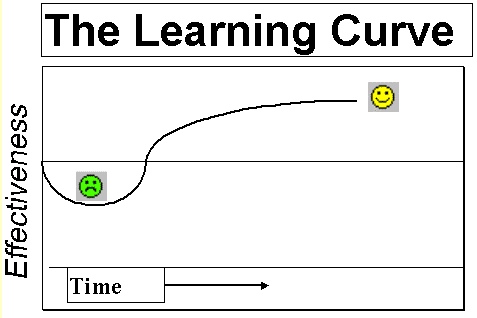
There is a steep learning curve in the course of raising children. Just when you think you have nearly figured out the secret to those complex chemical chain reactions the whole darned chemistry set blows up, and all you have is a mess in the kitchen.

Take heart, sweet parents. In every chaotic mess there is an opportunity to clean up the work space, fine tune the instruments, glean the data, analyze the sequences, and get a little breathing room, so you can start again. Persistence is your friend in the case of solving the parent/child relationship equation.

Parenting Learning Curve

Parenting Learning Curve

If your kitchen is blowing up, collect some meta data: What am I forgetting? What am I leaving out? What am I expecting? What is my goal? Where are my resources? Where is my heart? What are the basics–sensory,

The Attach Place

The Attach Place
Center for Strengthening Relationships

environment, connection, correction? What just happened? What did I do? Is there balance? Am I taking care of myself? Is relationship before compliance my mantra? What is the need? What is the point?

Learning curve or not, forward is the only way through. Persist.

Love Matters,

Ce

P.S. Sneak peek. I am excited to announce that in Sacramento, CA, The Attach Place’s Jennifer Olden, LMFT (Certified Supervisor of Emotionally Focused Therapy) and Robin Blair (EFT intern) are offering a reduced rate “Hold Me Tight” weekend workshop, March 21-23, 2014, especially for parents of attachment challenged children. This workshop is internationally celebrated as one of the most effective ways of strengthening the marriage/couple bond. There is limited space and YOU are the first to know! I will get you more details later this week. If you are interested, you can send an email to ce@attachplace.com. Stay tuned.

The Attach Place’s next Trust-based Parent Training Course begins March 29, 2014. Click here for more information. This is a link to the registration page.

Feel free to invite your friends and family to receive Daily YOU Time emails, too. Click here to sign them up. All you need is an email address and first name.

Attachment Panic–Freeze

Previously this week, I wrote about attachment panic reactions–fight and flight–and today’s topic is the third reaction in the trilogy, freeze. You will recall that attachment panic is often triggered when an attachment challenged person perceives deprivation or withdrawal of another’s love. The cellular memory of early deprivation and loss causes a reaction of fight, flight or freeze.
 
This is freeze:
When your 6 year old cuts her long hair on one side up to her ear and she faces your displeasure mute with wide open eyes while you ask her what in the world she was thinking; when your 15 year old glazes over like an ice statue when you approach him about stuffing his dirty laundry back into his drawers instead of the washer; when your 3 year old collapses to the floor in a fetal position just as you are leaving for work; when your 12 year old stares at you expressionless while yawning just as you are making a poignant point; when you see those blank, death grip, deer in the headlights, lights on no one home, checked out, empty faced stares, YOU are experiencing attachment panic freeze.
 
Try to remember that this is pure fear.  Take a deep breath or a little time out to regulate yourself, lower your intensity and voice tone, and soften your eyes, because you are scaring your child to death (again) if you don’t.  Nothing they have done is worth that.

Attachment Panic–Flight

Attachment panic can be as brutal for the attachment object (YOU) as it is for the person experiencing it. Attachment panic can occur when an attachment challenged person is triggered by perceived deprivation or withdrawal of another’s love. The cellular memory of early deprivation and loss causes a reaction of fight, flight or freeze.

This is flight:
When your 8 year old says nonsensical, random things when you are trying to make connection before you leave for work; when your 4 year old takes off running, forcing YOU to chase her to get her teeth brushed; when your 16 year old retreats to his room before you get two sentences out about the chores not being done; when your 12 year old loses about 8 years of brain power as you confront her on the family computer browser history that shows visits to unsavory websites; when these kinds of mind boggling events occur, YOU are experiencing attachment panic flight.

Try to step out of the trap of making sense of flight behaviors. They don’t make sense in the context of the moment. However, in the context of your child’s inner world fleeing from feelings of deprivation or fear of losing your love makes perfect sense.

Words Are Like Claws On Scared Cats

Attachment panic can be as brutal for the attachment object (YOU) as it is for the person experiencing it (your attachment challenged child or spouse.)  Attachment panic can occur when an attachment challenged person is triggered by perceived deprivation or withdrawal of another’s love. The cellular memory of early deprivation and loss causes a reaction of fight, flight or freeze.
 

Attachment Help

Comprehensive Attachment Therapy

This is fight:
When your three year old says with conviction, “I hate you” or “I only love Daddy,” as you head out the door for work; when your 11 year old lofts a hefty F-bomb at YOU, as you lovingly cajole him up in the morning for school; when your insecurely attached wife snidely quips how little she thinks of your love-making skill, as you pack for a 10-day business trip; when these kinds of things fly out of the mouth of someone in attachment panic, there is a brutality to it as sharp as claws on scared cats.  The words dig in, then drag across your heart leaving a trail of painful imprints that fester for days before they fade away. Sometimes the scars last a long time after the painful event has been forgotten.
 
Try to step out of the way of attachment panicked words, they are not meant to drive YOU away, but rather to pull YOU in.


Welcome to Wisdom For Adoptive Parents

I write this blog every day for parents of children with attachment challenges.  This is usually adoptive children; however, many times people find themselves here who are seeking information about parenting children with special needs.  YOU are welcome.  This blog is referred to as Daily YOU Time–Wisdom for Adoptive Parents.  I hope you can see what that means after reading a few posts.  My goal is to support you in doing the most difficult job on Earth–parenting attachment challenged children.

Attachment Help

The Attach Place
Center for Strengthening Relationships

Love Matters,

Ce Eshelman, LMFT

Attachment Specialist