|
|||
 |
 |
 |
|
Blessings Come In Strange Ways
Leave a reply
|
|||
|
|
|
|
I call this the “UP and DOWN Whiplash.” My emotions are in a perpetual “rear-ender.” The whiplash is profound. Put your neck brace on and steady on.
I am a grounded, loving person and my children struggle. That is a fact.
I put my oxygen mask on before assisting others. I have to. How about YOU?

The Attach Place
Center for Strengthening Relationships
Ce Eshelman, LMFT
One of my favorite parenting sentences (I think I stole from PCIT, but who can remember such details at my age?) to get the kids moving. I don’t know why this works so frequently, but it does. It’s sharing power, so it makes sense that it works, now that I think about it.
Okay, time to go to bed.
Noooooooo!!! I’m not done!
How much more time do you think you need? [That was the favorite sentence, though I see now that it is really a question, my favorite parenting question.]
10 minutes.
Let’s compromise–5 more minutes.
Awwwa, okay.
Two minutes later, he is done and down the hall to the bedroom.
I know you don’t believe me, so start small and build up to bedtime.
 My son has been home “sick” in bed for two days.
I asked him, How much more time do you think you need?
Uhh, I’m pretty sick. My stomach really has been hurting. Uh, a week?
Let’s compromise–you’re getting your butt to school to-mor-row.
It was worth a try, Mom.
We giggled. He’s going to school tomorrow.
Wow, crazy as it seems, I have raised a seriously reasonable kid. I worried that would never happen. I often had so little faith in the face of so much fear.
Good thing I kept putting one foot in front of the other. Just like YOU.


I received an email today from another therapist and adoptive mother asking me to clarify some things, and I thought it would be helpful to put some thoughts down for all of YOU at the same time.
Many of you are using the techniques of Nancy Thomas from her book entitled, When Love Is Not Enough. What I am about to write is not criticism of your choice to do so; however, I have some observations and experience about the methods I want to share.
When I write about how I deal with my kids, you may hear things that are Nancy Thomas-like. In my opinion some of the methods are helpful with very disorganized attachment challenged children. These are the most severely impacted children with the most disturbed attachment reactions–the ones that would be given a Reactive Attachment Disorder diagnosis. One of my children is clearly diagnosed with Reactive Attachment Disorder and continues to behave in adulthood the way she did in childhood–reactively. My other child is anxiously attached with PTSD, pervasive developmental delay, severe ADHD and learning disabilities. Together these two were tornados in our home.
At the time, the only attachment help I could find was based on Nancy Thomas’ work that involved holding children against their will, in effect, forcing them to submit to parental authority with physical restraint. I did that to them. I thought I had to. They were so incredibly self-destructive and reactive. I was desperate to gain control and Nancy Thomas’ approach gave me direction on how to do that. The only attachment therapist I could find back then followed the Thomas methods. So, I held my children against their will for hours on end, day after day, for several years when they were between 2-years-old and 5-years-old. I shut them down, powered over them, and used techniques that were somewhat humiliating and definitely emotionally confusing to them. I was not safe. They did not feel good about themselves or safe around me.
That somewhat stopped their intense, self-destructive behavior (until the teen years when it all resurfaced X10); however, that also caused them both to have posttraumatic stress from the trauma that forcefully holding them caused. They learned to fear me and when upset they would cower or rage at me. Since that time, 15 years ago, so much research, training, and information has surfaced about a better way, a loving way of creating attachment bonds that does not include authoritarian, physically abusive methods that create more trauma. I have read everything available on attachment and I have attended hundreds of hours of training over the years. I have made myself into an attachment therapist for others, so people can find help that is truly helpful and not abusive.
 If I had it to do all over again, I would NOT hold my children except for safety. I would do therapeutic, attachment parenting. I would up the sensory stimulation. I would focus on their felt safety and our relationship. I would play more, control less. I would smile and give up the mommy stink-eye. I would coach instead of lecture. I would never use coercive, degrading interventions like forced sit-ups and hard labor. Most importantly, I would get help for myself to regulate and deal with my own childhood trauma. I wish I had known what I know now.
I truly believe that much of what my children dished out in their teen years was a direct result of what I did to them in their early years. I was ill-informed and poorly supported by therapists then. I have had to forgive myself. I have had to ask my children for their forgiveness, but the damage to our relationship was honed in their early years. I have been trying to undo those early interventions for the last 10 years.
I know YOU wonder sometimes…if Ce has so much difficulty with her own children, then why would what she says be helpful to me and my children? The answer is that I did not do trust-based relational parenting early enough, and what I did do caused more harm. Ultimately, that is the sole reason why I have decided to devote my career to helping attachment challenged children and their parents. I am trying to give to YOU what I couldn’t get when I needed it most.

The Attach Place
Center for Strengthening Relationships
Love Matters,
Ce Eshelman, LMFT
To drive a point home and increase the likelihood of learning, surprise your child with a happy voice when usually there would be stern tones. On a particularly difficult afternoon, break the rules and get out the frozen yogurt for a pre-dinner treat and a little delicious conversation. Mix it up. You might have become boring.
Wah wa Wah.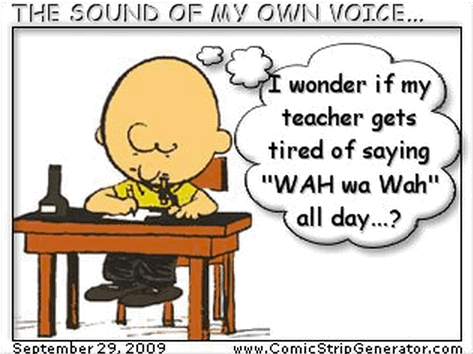
Surprise and novelty register differently in the brain. It’s more fun for YOU, too.
Love Matters,
Ce Eshelman, LMFT
The Attach Place
Center for Strengthening Relationships
The last text my 18.5 year-old daughter sent me said, “Okay, CE, I will be fine without you.” The meaning of her reference to my given name is clear—she no longer considers me to be her mother. This is not the first time for sure, but it may be the last.
Where to draw the line in the sand has been my constant dilemma since she was 3 years-old, running away 6 blocks to strangers she thought would be better parents. I was calling the police at the same time the kind strangers were calling them. I picked her up and drove her home in tears—I was in tears; she actually wasn’t. This or similar scenarios occurred countless times over the last 15 years.
My partner draws his line “here,” my therapist colleagues draw it “near” there, but YOU, you might feel the same as me—stumped to find a way to help my emotionally disabled daughter without enabling her to continue making poor choices that she doesn’t consider poor or that she sees as necessary given her situation.
My sweet friend, Grish, is the mother of a 26 year-old Autism Spectrum adult child and she completely understands why I keep throwing money, support and resources in my daughter’s direction. She instantly said, “It’s not codependence. It’s being a mother!” I love non-husband, non-therapist friends. ☺ I love the other’s too, but they don’t say what I want. My love is conditional. Ha.
 Now isn’t that an interesting thing out of the mouth of a non-therapist mother? Is mother synonymous with enabler? I am sure that book has been written, but I know I am in line if it hasn’t been. Many of you are in this situation because I have previously counseled you, or heard from you in regard to other emails I have written that describe this excruciating Push-me Pull-you. When in doubt, reference Dr. Doolittle, right?
My childless friends are very clear. By helping my daughter regularly get out of messy situations of her own making, I am enabling her to continue making poor decisions and, therefore, I should stop it. Just do it! They must have gone to Nike Business School–Just do it! My mother friends are very clearly empathetic and sorely lacking (thank goodness) black and white solutions. Life is grey. Take the middle road. Don’t be severe. She is young. YOU are her mother. Of course you want to continue to help her.
The Attach Place
Center for Strengthening Relationships
“Okay, CE, I will be fine without YOU,” sticks in my gut like a jagged knife. It is a familiar feeling I’ve had over the years. Cliches always come to mind in times like these, “If you love her, let her go.” The letting go probably never feels good.
Ce Eshelman, LMFT
I don’t want to go all Freudian on you, but that rage that you encounter in your children (and sometimes inside yourself); the kind where you want to scream something that will cut your partner, child, best friend to the core over some little slight; the one that overtakes your children and turns them into flailing, spewing, rage machines; that kind of rage; it is called narcissistic rage from narcissistic wounding in the early developmental years when there was a parenting failure of some kind and the child, at the time, is left feeling both wrathfully bad about him or herself and concomitantly angry at the person who failed him/her.
Our children often have this kind of rage because most of them were failed in the early developmental years. YOU may also have it because YOU were failed in your early  developmental years. That combo plate makes for a home like a hot tamale, where children feel hatefully bad about themselves and, simultaneously, overwhelming anger at their parents, and YOU experience the same thing in return.
If your home is a hot tamale, get some help for your family. Seriously, YOU cannot resolve things on your own. Trust me on this. YOU need your own heart repaired before you can revive the heart of your child. It’s the old oxygen mask analogy: in case the airplane cabin looses oxygen, put your mask on before placing one on your child.
The Attach Place
Center for Strengthening Relationships
Love Matters,
Ce Eshelman, LMFT
UPCOMING SPECIAL EVENTS:
Next Trust-based Relational Parent Training is scheduled for May 10th and 17th. It is close to full already, so go to http://www.attachplace.com to register soon to reserve your space. Each group has only 16 spaces. Ready, set, go.
Get more information and reserve your spot here for our upcoming Hold Me Tight Couples Workshop for Parents of Adopted, Attachment Challenged, and/or Special Needs Children in Sacramento, CA on April 25th, 26th and 27th.
Check out our three blogs:
http://www.lovestronglovelong.com
http://www.parentingwithheart.net
http://www.wisdomforadoptiveparents.com

 The Attach Place provides a monthly no fee
  Wisdom For Adoptive Parents