Tag Archives: parenting special needs children

State Dependent Learning

State-dependent memory, or state-dependent learning is the biological process through which memory retrieval is heightened and most efficient when an individual is in the same state of being (consciousness, mood, emotion) as they were when the memory was formed.  Context-dependent learning is the process through which memory retrieval is heightened when an individual is in the same place or environment as they were when the memory was formed.
When your child is ALWAYS reactive in specific places or ALWAYS reactive when hungry, then your are likely dealing with a combination of things, and state-dependent learning and context-dependent learning may be at work.  
 
So?
 
Well, this means you have some additional ways of helping your child recall what they have learned previously about managing their emotions, such as using their words or taking a breath.
 
Example for hunger reactive child: Proactively give healthy snacks at two hour intervals to prevent the internal state of hunger which triggers reactivity.
 
Example for a school reactive child:  Play some happy music at home while teaching your child to deep breathe.  Then, on the way to school in the car play the same happy music and practice deep breathing.
The Attach Place Logo
Love Matters,
Ce Eshelman, LMFT 

Our children have a story they tell themselves.  Do you know what your child’s internal story is?  You might hear it leaking out in times of emotional upheaval:  Nobody likes me.  I never get what I want. It’s too hard.  I can’t. You don’t love me.  I don’t love anybody.  I hate myself.  I hate everyone.  I can do it without anyone’s help. I don’t need you.  I don’t need love.  I hate love.
 
Having a coherent narrative is one of the keys to mental health. Whenever you can, tell your child the story you want them to tell themselves inside. YOU don’t need to make anything up.  Your child is precious, loved, planned, wanted, adored, valued, appreciated, and special.  Make sure you say these things all the time–10,000 times to make a new neuro-pathway.  
The Attach Place Logo  2
Love Matters,
Ce Eshelman, LMFT 

Hold Me Tight Couples Workshop for Parents of Attachment Challenged and Special Needs Children

sandy heart 2
Weekend
April 25, 2014   6pm to 9pm
April 26, 2014  10am to 4pm
April 27, 2014  10am to 1pm
Hold Me Tight
Weekend Workshop for Couples with Adopted and Special Needs Children
large_box_top.gif

The Hold Me Tight Workshop is designed to give you a weekend away to connect with your spouse. This workshop will not teach you useless things; it will give you an opportunity to fully engage the deep, loving connection you desire in your relationship with your partner.

• Address stuck patterns and negative cycles

• Make sense of your own emotions

• Overcome loneliness

• Repair and forgive emotional and physical disconnection

• Communicate to develop deeper understanding and closeness

You will strengthen your bond through private exercises with your partner, didactic experiences, and video demonstrations of couples that have moved from distress to that longed for deep, intimate connection.   This workshop takes place in the safe environment of experienced attachment specialists and other parents experiencing similar attachment pushes and pulls in their lives because of the demands of healing the broken hearts and emotional difficulties of children from difficult biological beginnings, maltreatment, abuse and attachment breaches.  YOU will be “seen” here and your struggles will be understood.

large_box_bottom.gif
spacer.gif
Hello Ce,
This attachment focused couples workshop is brought to you at a 50% reduced rate by The Attach Place Center for Strengthening Relationships. We believe that you, your relationship, and your love matter.  The stronger your relationship, the better able YOU will be to whether the slings and arrows of raising children from difficult beginnings. The Attach Place Logo  2

This workshop is especially designed with YOU in mind. To that end, we are dedicated to providing creative financing to make this opportunity possible for you and child care options.

Who:                YOU and Your Partner
When:                6pm to 9pm April 25, 2014
10am to 4pm April 26, 2014
10am to 1pm – April 27, 2014
Cost:                $300.00
Child Care:       $5 per hour per child

Snacks Provided and Local Restaurant List for Lunch Options.

Reserve your place by RSVPing to: info@attachplace.com

If you can carve out time for yourselves on a weekend, we promise that you will have valuable experiences to help you strengthening the safety, connection, and bond in your relationship.

Love Matters,
Ce Eshelman, LMFT, Jennifer Olden, LMFT, Robin Blair, MFTI,
The Attach Place
Center for Strengthening Relationships

Thoughts on When Love Is Not Enough

I received an email today from another therapist and adoptive mother asking me to clarify some things, and I thought it would be helpful to put some thoughts down for all of YOU at the same time.

Many of you are using the techniques of Nancy Thomas from her book entitled, When Love Is Not Enough. What I am about to write is not criticism of your choice to do so; however, I have some observations and experience about the methods I want to share.

When I write about how I deal with my kids, you may hear things that are Nancy Thomas-like. In my opinion some of the methods are helpful with very disorganized attachment challenged children. These are the most severely impacted children with the most disturbed attachment reactions–the ones that would be given a Reactive Attachment Disorder diagnosis. One of my children is clearly diagnosed with Reactive Attachment Disorder and continues to behave in adulthood the way she did in childhood–reactively. My other child is anxiously attached with PTSD, pervasive developmental delay, severe ADHD and learning disabilities. Together these two were tornados in our home.

At the time, the only attachment help I could find was based on Nancy Thomas’ work that involved holding children against their will, in effect, forcing them to submit to parental authority with physical restraint. I did that to them. I thought I had to. They were so incredibly self-destructive and reactive. I was desperate to gain control and Nancy Thomas’ approach gave me direction on how to do that. The only attachment therapist I could find back then followed the Thomas methods. So, I held my children against their will for hours on end, day after day, for several years when they were between 2-years-old and 5-years-old. I shut them down, powered over them, and used techniques that were somewhat humiliating and definitely emotionally confusing to them. I was not safe. They did not feel good about themselves or safe around me.

That somewhat stopped their intense, self-destructive behavior (until the teen years when it all resurfaced X10); however, that also caused them both to have posttraumatic stress from the trauma that forcefully holding them caused. They learned to fear me and when upset they would cower or rage at me. Since that time, 15 years ago, so much research, training, and information has surfaced about a better way, a loving way of creating attachment bonds that does not include authoritarian, physically abusive methods that create more trauma. I have read everything available on attachment and I have attended hundreds of hours of training over the years. I have made myself into an attachment therapist for others, so people can find help that is truly helpful and not abusive.

handsIf I had it to do all over again, I would NOT hold my children except for safety. I would do therapeutic, attachment parenting. I would up the sensory stimulation. I would focus on their felt safety and our relationship. I would play more, control less. I would smile and give up the mommy stink-eye. I would coach instead of lecture. I would never use coercive, degrading interventions like forced sit-ups and hard labor. Most importantly, I would get help for myself to regulate and deal with my own childhood trauma. I wish I had known what I know now.

I truly believe that much of what my children dished out in their teen years was a direct result of what I did to them in their early years. I was ill-informed and poorly supported by therapists then. I have had to forgive myself. I have had to ask my children for their forgiveness, but the damage to our relationship was honed in their early years. I have been trying to undo those early interventions for the last 10 years.

I know YOU wonder sometimes…if Ce has so much difficulty with her own children, then why would what she says be helpful to me and my children? The answer is that I did not do trust-based relational parenting early enough, and what I did do caused more harm. Ultimately, that is the sole reason why I have decided to devote my career to helping attachment challenged children and their parents. I am trying to give to YOU what I couldn’t get when I needed it most.

Attachment Help

The Attach Place
Center for Strengthening Relationships

Love Matters,
Ce Eshelman, LMFT

Surprise and Novelty Increase Learning

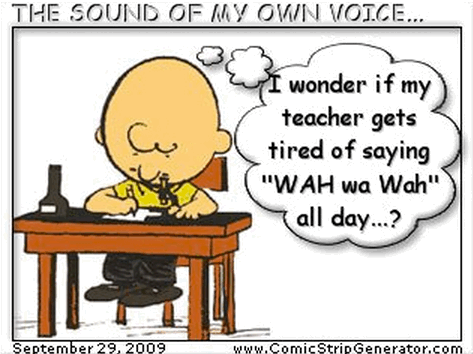
To drive a point home and increase the likelihood of learning, surprise your child with a happy voice when usually there would be stern tones. On a particularly difficult afternoon, break the rules and get out the frozen yogurt for a pre-dinner treat and a little delicious conversation. Mix it up. You might have become boring.
Wah wa Wah.charlie brown

Surprise and novelty register differently in the brain. It’s more fun for YOU, too.

Love Matters,
Ce Eshelman, LMFT

Attachment Help

The Attach Place
Center for Strengthening Relationships

Narcissistic Wounding

I don’t want to go all Freudian on you, but that rage that you encounter in your children (and sometimes inside yourself); the kind where you want to scream something that will cut your partner, child, best friend to the core over some little slight; the one that overtakes your children and turns them into flailing, spewing, rage machines; that kind of rage; it is called narcissistic rage from narcissistic wounding in the early developmental years when there was a parenting failure of some kind and the child, at the time, is left feeling both wrathfully bad about him or herself and concomitantly angry at the person who failed him/her.

Our children often have this kind of rage because most of them were failed in the early developmental years. YOU may also have it because YOU were failed in your early Hot Tamalesdevelopmental years. That combo plate makes for a home like a hot tamale, where children feel hatefully bad about themselves and, simultaneously, overwhelming anger at their parents, and YOU experience the same thing in return.
If your home is a hot tamale, get some help for your family. Seriously, YOU cannot resolve things on your own. Trust me on this. YOU need your own heart repaired before you can revive the heart of your child. It’s the old oxygen mask analogy: in case the airplane cabin looses oxygen, put your mask on before placing one on your child.

Attachment Help

The Attach Place
Center for Strengthening Relationships

Love Matters,
Ce Eshelman, LMFT

UPCOMING SPECIAL EVENTS:
Next Trust-based Relational Parent Training is scheduled for May 10th and 17th. It is close to full already, so go to http://www.attachplace.com to register soon to reserve your space. Each group has only 16 spaces. Ready, set, go.

Get more information and reserve your spot here for our upcoming Hold Me Tight Couples Workshop for Parents of Adopted, Attachment Challenged, and/or Special Needs Children in Sacramento, CA on April 25th, 26th and 27th.

Check out our three blogs:
http://www.lovestronglovelong.com
http://www.parentingwithheart.net
http://www.wisdomforadoptiveparents.com

This Is Controversial

YOU are so important to the life of your attachment challenged, special needs child.  Get respite, regulation and relief.  If you think you can white knuckle it, YOU are mistaken.  In the end, your child will suffer.  I keep saying this and still some of YOU are not doing it.  Get the help you need, now, before your child is too frozen-over to heal.
 
I know it is hard to do.  I know it costs too much.  I know you don’t have the time.  I know how desperate you are. And, I know you need help.  Don’t be too proud, too hurt, too tough to let someone help you do this.  It is near impossible to parent attachment challenged children without support.  YOU are not alone, unless YOU choose to be.

The Attach Place Logo

Love Matters,
Ce Eshelman, LMFT 
UPCOMING SPECIAL EVENTS:
Next Trust-based Relational Parent Training is scheduled for May 10th and 17th.  It is close to full already, so go to www.attachplace.com to register soon to reserve your space.  Each group has only 16 spaces.  Ready, set, go.
 
Get more information and reserve your spot for our upcoming Hold Me Tight Couples Workshop for Parents of Adopted, Attachment Challenged, and/or Special Needs Children in Sacramento, CA on April 25th, 26th and 27th.
Check out our three blogs:


Triggering Behaviors

I hope you had super wonderful parenting when YOU were a child. If you did, then YOU are one of the best people to have chosen adoption. Why do I say this? Besides the obvious (well-grounded, deeply loved, secure at the core), YOU have a sturdy foundation covered in emotional down that can provide at once a stable and soft landing place for your child from difficult beginnings. While it takes every ounce of strength and emotional constraint for you to parent your child with attachment challenges, YOU likely have the inner resources and hardwired brain to whether the storms on your parenting path.

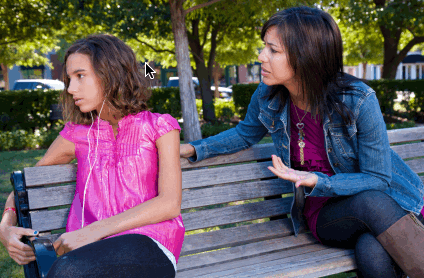
mother daughter conflictIf you had less that secure parenting, YOU may be fiercely struggling to create a safety zone for your adopted child. When you decided to adopt, you may have thought your own difficult beginnings would make you just right for the task. After all, you have been through it. YOU know what it is like to have a tough childhood. This thinking is extremely honorable, however, misinformed. I say this because you may be finding that you are prone to being triggered by your child’s behavior, making YOU emotionally unstable, volatile and distressed beyond your wildest imagination.

When I write these things, of course, I am aware that there are exceptions. If YOU are an exception, I trust you to take what you need and leave the rest.

Personally, I am an example of the adoptive parent from difficult beginnings. YOU already know that because I write about my reactivity all the time. Because of this, I needed to work all the time on myself. I WAS the problem most of the time. My kids were wounded and I contributed to their insecurity by reacting out of my own. Once I truly understood that, I stopped blaming the kids for ruining my otherwise wonderful life. Then, my love and empathy began to grow and I was better able to give what they needed, rather than react when I didn’t get what I needed.

Attachment Help

The Attach Place
Center for Strengthening Relationships

Frankly, I needed their love. They needed mine first to do that. There in lies the rub. To be a healing parent to your child from difficult beginnings, YOU have to love first and for long. If you can do that, your child’s love for YOU will show up…down the road.

Love Matters,
Ce Eshelman, LMFT

UPCOMING SPECIAL EVENTS:
Get more information and reserve your spot here for our upcoming Hold Me Tight Couples Workshop for Parents of Adopted, Attachment Challenged, and/or Special Needs Children in Sacramento, CA on April 25th, 26th and 27th.

Check out our three blogs:
http://www.lovestronglovelong.com
http://www.parentingwithheart.net
http://www.wisdomforadoptiveparents.com

Being A Parent Is Hard, Duh!

This is a “duh” statement, Being a parent is hard. Duh. Being a parent of an attachment challenged child is harder. Duh.

I am working every day to be a loving mother to my 18-year-old daughter. She would say I am not being loving at all. I am trying fiercely not to enable her to make poor choices by bailing her out of financial messes. She depends on me to have little resolve in this matter, but I am determined to stay firm–just as I wrote that my inner doubter whispered “I think” in my ear.

Mother DaughterBeing an attachment therapist in no way helps me with my parent/child struggle. When it comes to my daughter, I am near blind and seriously feeble-minded. I cannot tell the difference between loving and enabling her. Before I respond to any of her requests of me I have to run my thinking by my partner at home and a colleague at work, lest I do a seriously enabling act. It’s unbelievable to me that I am so mush brained with her. When it gets down to the core of it, I see her attachment challenge as a disability and I forgive so many things that are completely off because of that.

When someone makes poor choices day in and day out since they were 3-years-old, it feels hard to insist they make good ones before they can get my help. I read that last sentence to my partner and he said, “YOU have given her help for 15 years and she has never been willing to live inside the boundaries of our home or society. YOU have helped her a lot and you will have to do that the rest of your life because she will not choose a different path.” Thank goodness he was offering me a freshly made cappuccino when he said this or I might have bitten his face off. Instead, tears come to my eyes because I am gut-deep sad that I cannot save my daughter from herself, disability or not.

Attachment Help

The Attach Place
Center for Strengthening Relationships

Enabling hurts. Love matters. Love is not enough. Life is not a quote. Parenting is hard. Duh.

Love Matters,
Ce Eshelman, LMFT and Mother
Attachment Specialist and
Parent Whisperer

Fun with Boundaries

Hi Sweet Parent–AKA, Child Whisperer,

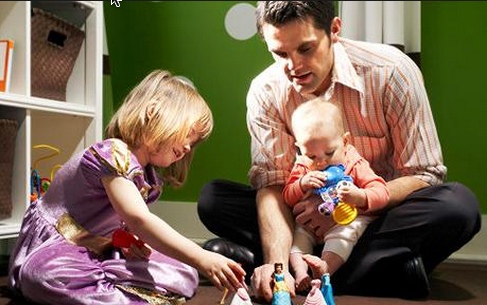
Parent PlayingHaving fun is imperative for raising healthy children with attachment challenges. Play with boundaries is the way to go. Use your sense of humor and playfulness to teach expectations, social skills, and appropriateness. Stop the fun to set a firm boundary, when the train suddenly goes off the rails. Then, go right back to being playful. This way of engaging your child will help her learn regulation and to accept your wisdom.

Watch your own tendency to be sarcastic, dry, and snarky. If that is your style of play, you won’t be surprised then when your child returns your humor with sarcasm, sharp sardonic quips, and snark. I learned this the hard way. Keep your humor innocent and playful, rather than quick and cutting. YOU and your child deserve the lightness of being silly, emotionally safe, and joyfully engaged.

Attachment Help

The Attach Place
Center for Strengthening Relationships

Love Matters,
Ce Eshelman, LMFT and Mother
Attachment Specialist and
Parent Whisperer